




 dbForge Studio
 10Web
10Web Dreamweaver
 Instapage
 Windsurf
 Replit
 SQL Server
 Antigravity
-
Latest Version
OpenCV 4.13.0 LATEST
-
Review by
-
Operating System
Windows 7 / Windows 8 / Windows 10 / Windows 11
-
User Rating
Click to vote -
Author / Product
-
Filename
opencv-4.13.0-windows.exe
Originally developed by Intel, OpenCV has grown into one of the most widely used frameworks for image processing, object detection, facial recognition, and deep learning tasks.
It provides a robust and efficient platform for developers, researchers, and engineers working in fields such as robotics, augmented reality, surveillance, and medical imaging.
Key Features
Extensive Computer Vision Capabilities – Offers a vast range of image processing techniques, including edge detection, segmentation, and feature extraction.
Machine Learning Integration – Supports deep learning models via frameworks like TensorFlow, PyTorch, and Caffe.
Multi-Language Support – Works with Python, C++, Java, and MATLAB, making it versatile for developers.
Cross-Platform Compatibility – Runs on Windows, Linux, macOS, iOS, and Android.
Optimized for Performance – Utilizes hardware acceleration via OpenCL, CUDA, and Intel’s MKL.
Video Processing – Features real-time video capture, processing, and motion detection.
3D Reconstruction – Offers tools for depth estimation, stereo vision, and point cloud generation.
Augmented Reality and Facial Recognition – Provides functionalities for AR applications and biometric identification.
User Interface
Since OpenCV is a library, it does not have a traditional graphical user interface (GUI).
Instead, it is used via command-line interfaces and integrated into development environments such as Visual Studio, PyCharm, and Jupyter Notebook.
Various wrapper libraries, such as OpenCV GUI (Qt-based) and OpenCV-Python, enable visualization of image and video processing tasks.
Installation and Setup
Building from Source:
- Install CMake, Visual Studio, and Ninja.
- Configure using CMake, enabling CUDA or OpenCL if necessary.
- Compile and integrate with Python or C++.
Is OpenCV free?
Yes, OpenCV is open-source and licensed under Apache 2.0, meaning it's free for both personal and commercial use.
What programming languages does OpenCV support?
It supports C++, Python, Java, and MATLAB, making it accessible for a wide range of developers.
Can OpenCV be used with deep learning models?
Yes, it integrates with TensorFlow, PyTorch, and Caffe for deep learning applications.
Does OpenCV support GPU acceleration?
Yes, it supports CUDA, OpenCL, and Vulkan for GPU acceleration.
What industries use OpenCV?
OpenCV is used in healthcare, robotics, security, automotive, and entertainment industries for tasks like facial recognition, autonomous driving, and AR applications.
System Requirements
- OS: Windows 10 or Windows 11
- Processor: Intel or AMD 64-bit CPU
- RAM: Minimum 4GB (8GB+ recommended)
- Storage: ~1GB for the base library; more for additional models and dependencies
- GPU: Optional, but NVIDIA CUDA-supported GPUs can improve performance
- Free and open-source with an active community.
- Extensive features for image processing, video analysis, and AI.
- High performance with GPU acceleration.
- Compatible with multiple programming languages.
- Works on various platforms including Windows, Linux, and macOS.
- No built-in GUI, making it challenging for beginners.
- Requires coding knowledge to utilize fully.
- Some features have a steep learning curve.
- GPU acceleration setup can be complex.
- Lacks official technical support (community-driven help only).
OpenCV remains one of the most powerful and versatile tools for computer vision and machine learning applications on Windows. While it may not be the most user-friendly option for beginners, it offers unparalleled flexibility and performance for developers working on AI-driven image processing projects.
With its strong community support, cross-platform functionality, and continuous improvements, OpenCV is an essential tool for anyone involved in computer vision.
Also Available: Download OpenCV for Mac
-
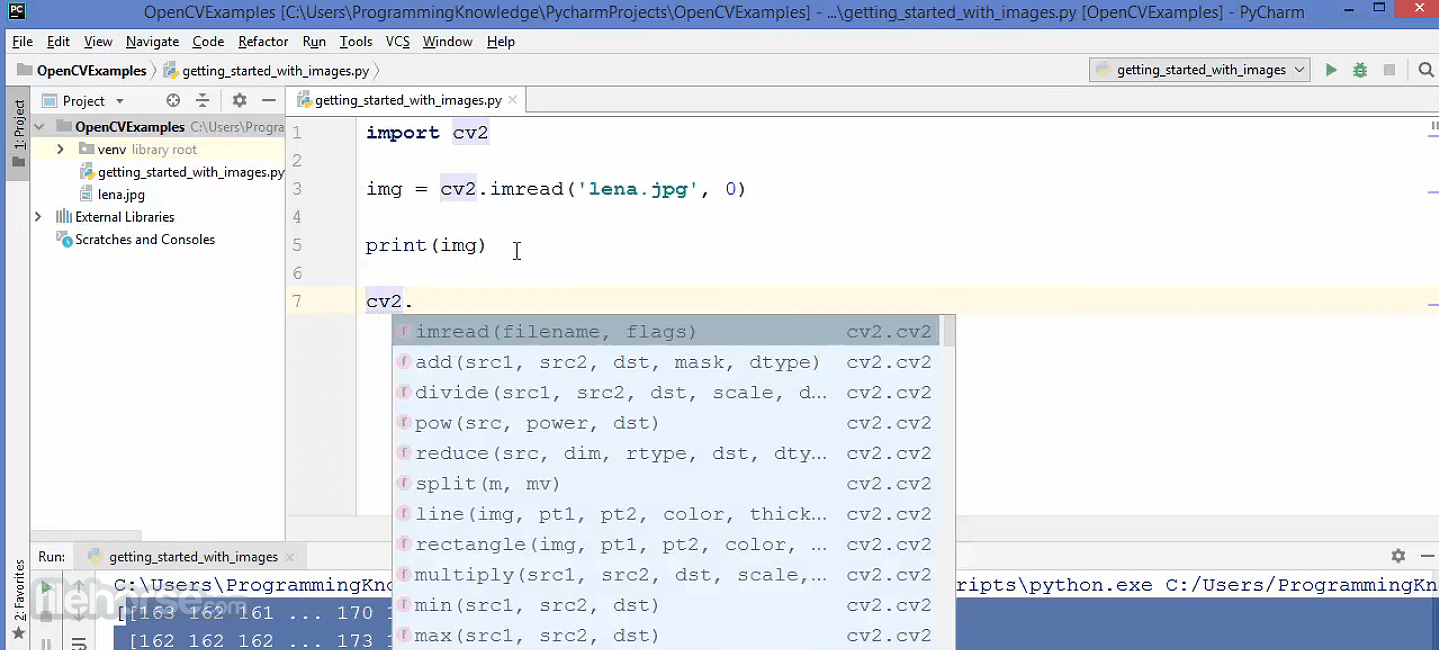
OpenCV 4.13.0 Screenshots
The images below have been resized. Click on them to view the screenshots in full size.

-

-
-

What's new in this version:
Core module:
- Modified Input/OutputArray methods to handle 'std::vector' or 'std::vector<std::vector>' in more accurate way
- Made cuda::GpuMatND compatible with InputArray/OutputArray
- Forced output type for empty matrices where it's defined in API
- Added std::vector length check Input/OutputArray
- Added 16-bit LUT and corresponding HAL entrypoint
- Add cv::Mat::copyAt for for ROI operation
- Extended JSON support in cv::FileStorage: null parsing
- Added support parsing null in JSON parser in cv::FileStorage
- Fixed cv::solveCubic numerical instability via coefficient normalization
- Fixed tempfile race condition on Windows
- Restore parallel framework name on failure attempt
- Dropped OPENCV_FOR_OPENMP_DYNAMIC_DISABLE environment variable in favor of standard OMP_DYNAMIC
- Enabled fp16 conversions, but disabled NEON FP16 arithmetics on Windows for ARM
- Fixed dot product accumulation causing NORM test failures on Windows ARM64
- Added several performance optimizations for Windows on ARM:
- Fixed missing vec_cvfo on IBM POWER9 due to unavailable VSX float64 conversion
- Fix in-place flip in HAL for RISC-V RVV
- Added inRange HAL entry point
- Disabled IPP with AVX512 in cv::compare because of performance regression
Imgproc module:
- Added Iterative Phase Correlation
- Added cv::minEnclosingConvexPolygon
- Improved near-zero convexity handling in cv::convexHull
- Kept cv::convexHull output indices monotone if possible
- Fixed overflow in connected components
- Corrected cv::minAreaRect to follow documentation (force angle to range [-90, 0))
- Increased minAreaRect accuracy with doubles
- Added cv::CLAHE::BitShift option
- Fixed cv::minEnclosingCircle
- Fixed standard cv::HoughLines output shift for rho.
- Fixed LINE_4/LINE_8 swap in cv::drawContours
- Fixed bug in approxPolyDP: calculate distance to a segment, not to a line
- Various performance optimizations for Gaussian Blur, including AVX512
- Added CV_SIMD_SCALABLE branch to pointSetBoundingRect
- Added Canny, Scharr and Sobel for riscv-rvv hal
- Optimized ThickLine() for distant points
- Fixed heap-buffer-overflow in stackBlur
- Fixed the out-of-bounds read in cv::bilateralFilter for 32f images
- Fixed memory leak in ipp_warp function
- Set limitation to IPP Bilateral Filter tiles number to avoid too small tiles
- Fixed incorrect implementation of multi-threaded call for warp perspective in IPP HAL
- Added stateless HAL for filters and morphology
Imgcodecs module:
- Extended metadata support in Jpeg (ICCP and XMP)
- Added OpenEXR multispectral read/write support
- Added strict validation for encoding parameters
- Relaxed decoding size limit to over 1 GiB for several formats
- Added IMWRITE_PNG_ZLIBBUFFER_SIZE option support for PNG
- Fixed memory leak in WebP backend
- Added workaround for image flipping bug in older GDAL FITS drivers
- Added support for 32bpp BMP with BI_BITFIELDS
- Fixed several overflow and out-of-bound access issues in BMP
- Fixed potential crashes in PNG found by fuzzer. Namely 429429085, 429645379, 430091585
- Fixed several potential overflows and error handling mistakes in PNG
- Fixed alpha handling for blending in PNG format
- Set matrixCoefficients to UNSPECIFIED for monochrome images in AVIF
- Added safety checks for AVIF decoder and encoder
VideoIO module:
- Added option to open camera device by index through FFmpeg
- Extended Orbbec SDK support: added timestamps
- Extended Aravis SDK support: allowed system-wide installation of SDK
- Added macOS support for Orbbec Gemini330 camera
- Fixed frame seeking with negative DTS values in FFMPEG backend
- Fixed CvCapture_FFMPEG::setProperty(CAP_PROP_POS_*) followed by getProperty
- Added Raspberry Pi 4 and 5 V4L2 Stateless HEVC Hardware Acceleration with FFmpeg
- Optimized FFmpeg VideoCapture with swscale threads option
- Fix return code from CvVideoWriter_FFMPEG::writeFrame() when encapsulating
- Added OPENCV_FFMPEG_SKIP_LOG_CALLBACK to preserve custom FFmpeg logging
- Get code to compile without FFMPEG's libavdevice
- catch _com_error exceptions to suppress debugger flooding
- Fixed picture_sw object leak in ffmpeg backend with hardware codecs.
- videoio(dshow): Fix incorrect mapping for White Balance Temperature (CAP_PROP_WB_TEMPERATURE) property
- Fixes a crash on iOS when calling VideoWriter::release() in OpenCV 4.12.0
Features2D module:
- Fixed ORB inconsistency for masks with values differs from 255
- Fixed pointer arithmetic in BRISK corner traversal
- Added heuristic to allocate buffer for FAST features depending on input image resolution
- Optimized AGAST for Windows on ARM
- Added FAST to RISC-V RVV HAL
Objdetect module:
- Added pixel-based confidence in ArUco marker detection
- Improved multiple QR codes detection with QRCodeDetector::detectAndDecodeMulti
- Fixed to prevent QR code decoding from throwing on degenerate source points
- Fix QRCodeDetector::detectAndDecode crash in case of inconsistent detection
- Remove floating point arithmetic from angle computation in QR codes
- Speedup ChArUco by avoiding temporary copies
- Fixed stack-use-after-scope errors in charuco detector
- Used fast-path with INTER_LINEAR resize when ALGO_HINT_APPROX is used in HOG 27706
DNN module:
- Added more layers support: ONNX randomNormalLike
- Allowed protobuffer message to be compiled with LITE_RUNTIME
- Fixed ONNX Convolution node parsing when kernel size is implicit
- Fixed Windograd flag handling in convolution layer
- Added NEON intrinsics implementation of fastGEMM1T function
- Add SVE optimized fastGEMM1T function and SVE dispatch
- Fixed heap-buffer-overflow in DNN NaryEltwiseLayer
- Improved performance of softmax_3d with loop unrolling
Calib3d module:
- Added estimateTranslation2D()
- Replaced Gao P3P with Ding P3P algorithm
- Added QR decomposition option to stereoCalibrate
- Improved fisheye::undistortPoints convergence
- Fixed invalid memory access in USAC
- Fixed out of bounds in calibrateAndNormalizePointsPnP
Stitching module:
- Fixed multiband blender memory leak 27333
- Pass warp parameters by value to avoid CUDA constant races
- Optimized fast.cpp on Windows ARM with loop unrolling
HighGUI module:
- Fixed linking for HighGUI against Qt 6.9 and newer
- Fixed Qt HighGUI lifecycle issue when external QApplication exists
- Fixed memory leak in CvWindow Qt back-end
G-API module:
- Added G-API custom stream sources in Python
- Implemented cfgEnsureNamedTensors option to OpenVINO Params
- Implemented cfgClampOutputs option to OpenVINO Params
- Renamed WorkloadType::notify() -> WorkloadType::set()
- Added support to set workload type dynamically in both OpenVINO and ONNX OVEP
- Fixed null pointer dereference in G-API stateful kernels
- Updated deprecated ov::element::undefined
Video module:
- Added multichannel support for findTransformECC and computeECC
- Add optional template mask for findTransformECC
- Added optional Known Foreground Mask for Background Subtractors
- Add setCoarsestScale to DISOpticalFlow
- Fixed potential pointer overflow in Farnback optical flow
ML module:
- Fixed ml::KDTree::findNearest
Photo module:
- Added 16U and 32F support in merge functions in photo module
JavaScript bindings:
- Added option to wrap opencv_contrib into JS too
- Fixed string property bindings in JS generator
- Update helpers.js to include .delete
- Added deep copy behavior for Mat.clone()
- Removed deprecated DEMANGLE_SUPPORT option
- Tuned CONV_NR_FP32 size for WASM
- Added large scalar kernel for fastconv
- Fixed generation when returned class and function are in a namespace
- Fixed JS bindings for namespaced Ptr factory return types
Python bindings:
- Tuned Python bindings for logging
- Marked Feature2D.detectAndCompute mask as optional in Python type stubs
- Marked distCoeffs/R/D as optional in calib3d functions
- Added DLPACK support
- Fixed memory leaks in pybindings
- Add PathLike type hints for args annotated with CV_WRAP_FILE_PATH
- Fixed memory leak in pyopencv_to for path-like objects
- Tunned Python bindings: use export_name as resolved typename for AliasTypeNode
- python: fix pytest-cov false warnings by using compile() with full file path in exec_file_wrapper
- Fixed python scalar typing issues
- Fixed bug in ifdef state machine in header parser for bindings
- Wrap GridType field in cv::findCirclesGrid parameters structure
Java bindings:
- Introduced option to generate Java code with new Cleaners interface or old finalize()
- Enabled Java wrapper generation for Vec4i
- Added Java wrapper support for List<List>
Applications and Tools:
- Improved interactive calibration tool: added option to select camera backend
- Aligned calibration tools and samples output fields to make them reusable in further steps
- Used calibration board imperfectness correction only for the cases where it's applicable
- Added option to define Aruco index offset in pattern generator
- Moved pattern generator to apps and rewrote tutorial
- Fix charuco_board_pattern in generate_pattern.py
- Updated Tutorial PSNR for identical images
Build:
- Integrated KleidiCV version 0.7 with Mac and Linux support (enabled by default)
- Integrated IPP ICV with AWX512 support.
- Fixed issues identified by PVS Studio
- Added support MS Visual Studio 2026 support
- Added CUDA 13.0 support
- Fixed OpenBLAS detection
- Added reproducible builds support by making host system version optional
- Fixed build issue with some old GCC versions
- Fixed unicode tracing symbols with QT
- Fixed eigen diagnostics for versions after v3.4.0
- Added CMake define option to enforce IPP calls in IPP HAL
 OperaOpera 132.0 Build 5905.11 (64-bit)
 AdsPowerAdsPower - Antidetect Browser
 PhotoshopAdobe Photoshop CC 2026 27.7 (64-bit)
 BlueStacks AIBlueStacks AI
 OKXOKX - Buy Bitcoin or Ethereum
 CapCutCapCut Desktop 8.5.0
 PC RepairPC Repair Tool 2026
 Hero WarsHero Wars - Online Action Game
 TradingViewTradingView - Trusted by 100 Million Traders
 Forza HorizonForza Horizon 6
Comments and User Reviews